Biphasic Defibrillator Monitor About
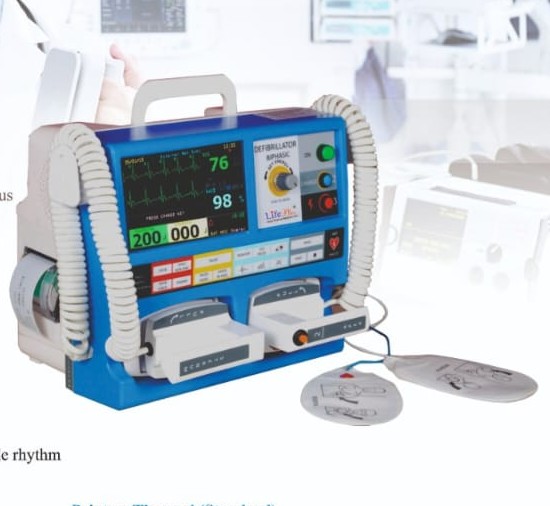
The LifePlus Biphasic Defibrillator (Model LPM-403B) is an advanced medical device used for cardiac resuscitation and patient monitoring in critical care settings. It is designed for use on adult, pediatric, and neonatal patients.
Key Features and SpecificationsThe LifePlus LPM-403B combines biphasic defibrillation technology with an integrated cardiac monitor and built-in printer.
- Display: Features a high-resolution 7-inch color TFT screen for clear visualization of ECG waveforms and vital signs.
- Defibrillation: Utilizes biphasic waveform technology and offers adjustable energy levels up to 360 Joules.
- Operating Modes: Supports manual defibrillation and synchronized cardioversion, with an optional external pacing function depending on the model.
- Monitoring: Includes an integrated cardiac monitor for real-time ECG analysis, and depending on the configuration, may also monitor SpO2, NIBP, respiration, and temperature.
- Portability: Designed to be portable and durable, making it suitable for use in hospitals, emergency rooms, ICUs, and ambulances.
- Battery: Equipped with a rechargeable battery backup to ensure uninterrupted operation during transport or power loss.
- Data & Printing: Includes a built-in high-speed thermal printer for instant documentation of ECG and event reports, and internal memory for storing patient event data.
- Paddles: Compatible with both adult and pediatric paddles.
Efficient Energy Management and OperationThe defibrillator's energy levels are selectable from 1 to 360J, accommodating diverse resuscitation needs. Fast charging (<5 seconds to 360J) ensures readiness during emergencies, while interchangeable adult and pediatric paddles enhance versatility. Its large, graphical LCD offers clear monitoring and control, streamlining workflow in high-pressure scenarios.
Advanced Monitoring and Data HandlingIntegrated ECG input, via leads or paddles, provides real-time cardiac monitoring. The built-in thermal printer delivers immediate event reports, while event storage holds up to 100 cases with waveform data, ensuring detailed records for critical follow-up and compliance.
Portability and Safety FirstWeighing just 7.5 kg and encased in durable ABS plastic/metal, the device is portable and resistant to shock and vibration for demanding environments. Key safety features include a built-in self-test, overcharge protection, error prompts, and robust audio/visual alarms, supporting continuous, reliable operation up to 4 hours on battery power.
FAQ's of Biphasic Defibrillator Monitor:
Q: How is energy selection managed on the biphasic defibrillator monitor?
A: Energy can be manually selected from 1 up to 360 Joules, or the device can operate in AED mode for automated selection. This flexibility ensures appropriate energy dosing for adults, pediatrics, and neonates during resuscitation.
Q: What are the main benefits of the dual manual and AED operating modes?
A: Manual mode allows trained professionals to adjust energy and timing, while AED mode automates detection and shock delivery for rapid intervention by any responder. This ensures fast, effective treatment in both clinical and emergency field settings.
Q: When and where can this defibrillator be safely used?
A: Designed with environmental tolerance for shock, vibration, and wide temperature/humidity ranges, the unit is suitable for hospitals, ICUs, ambulances, and emergency outdoor locations, providing stable operation wherever cardiac emergencies arise.
Q: What is the process for recording and retrieving event data?
A: During use, the device automatically stores up to 100 events-including waveform data-in internal memory. The built-in thermal printer can generate immediate event reports for documentation or handover.
Q: How does the alarm system support patient safety?
A: The alarm system provides both audio and visual alerts for critical issues such as asystole, arrhythmia, and low battery, ensuring the responder is immediately aware of any urgent patient condition or device status changes.
Q: What usage and maintenance steps ensure long-term reliability?
A: The defibrillator performs regular self-tests and displays error prompts. Operators are advised to keep it charged, conduct routine checks, and follow manufacturer guidelines for cleaning and paddle maintenance to maximize dependability.
Q: What are the key benefits of the device's portability and power options?
A: Weighing approximately 7.5 kg and equipped with AC or rechargeable battery power (operating up to 4 hours), the monitor is easy to transport between care locations and maintains full functionality even during power fluctuations or field use.




 Send Inquiry

 Send Inquiry
 Send Inquiry
 Send SMS