Elisa Reader About
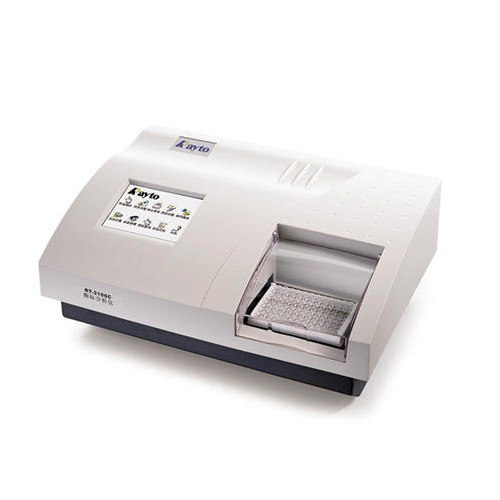
The Rayto RT-2100C is a compact, automatic microplate reader designed for clinical diagnostics, featuring an 8-channel optical fiber system that reads a full 96-well plate in 5 seconds. It utilizes a Windows-based system with a touch-screen display, supports multiple assays (up to 12) per plate, and provides extensive data management with storage for 10,000 results
Key Features and Specifications:
- Operating System: Easy Windows-based interface with large LCD touch screen.
- Reading Speed: 5 seconds for a 96-well plate (single wavelength).
- Optical System: 8-channel optical fiber system with a spectral range of 405, 450, 492, 630nm, and 4 optional filters.
- Measurement Modes: Absorbance (ABS), Cut-Off, Curve, Linear, Log, and Exponent regression.
- Capacity: Stores up to 100 test protocols and 10,000 test results.
- Quality Control: Includes Westguard rules, Levey-Jennings plots, and Grubs test.
- Functionality: Plate shaking (with speed/time control) and auto power-on self-check.
- Connectivity: Supports PC connection for data managemen
Advanced Optical System and Fast OperationEquipped with a high-precision optical system, this ELISA reader offers a wavelength range from 400 nm to 750 nm, allowing flexibility for different assay protocols. Its superior reading speed-less than 5 seconds per well-makes it ideal for high-throughput environments, minimizing processing time without compromising accuracy.
User-Friendly Design and Data ManagementThe ELISA reader features a simple keypad-operated interface and bright LCD, ensuring ease of use for laboratory staff. With built-in thermal printing and a USB data port, data management and result documentation are seamless. The device supports internal storage for up to 1000 test results, providing reliable backup and easy retrieval.
Robust Safety and CompatibilityDesigned for reliability, the reader includes overload protection and optical fault detection for equipment and user safety. It is compatible with Windows operating systems, making integration into existing lab setups straightforward. The sturdy ABS plastic housing and internal backup make it suitable for high-usage labs in clinical or research settings.
FAQ's of Elisa Reader:
Q: How does the ELISA reader ensure accurate results during measurements?
A: The ELISA reader achieves high accuracy (0.01 Abs) using a precision optical system with a halogen light source and automatic calibration before tests. Its dedicated filter slots and advanced optical fault detection further enhance the reliability of each measurement.
Q: What types of microplates are compatible with this ELISA reader?
A: This device is compatible with 96-well microplates featuring flat, U, and V-bottom designs, providing versatility for various assay formats commonly used in clinical diagnostics and research laboratories.
Q: When should calibration be performed, and is it manual or automated?
A: Calibration on this ELISA reader is fully automated and typically occurs before each assay run, ensuring measurement consistency and minimal user intervention, which is crucial for routine and high-throughput laboratory operations.
Q: Where can the test data be stored or exported from the ELISA reader?
A: Test data can be saved internally on the device's memory, which holds up to 1000 test results. For external documentation or analysis, results can be exported via the USB data port or printed using the integrated thermal printer.
Q: What is the process for reading and exporting results from a 96-well plate?
A: Place the microplate in the reader and select the assay parameters using the keypad interface. The device automatically reads each well in less than 5 seconds per well. Results can then be viewed on the LCD, printed immediately, or exported via USB for further analysis.
Q: How is user safety ensured during operation?
A: The reader includes built-in overload protection and optical fault detection systems, reducing the risk of equipment damage or data errors. Its sturdy ABS housing also offers electrical insulation and impact resistance, providing an extra layer of safety for users.
Q: What are the main benefits of using this ELISA reader in a clinical or research setting?
A: Benefits include rapid and precise automated readings, user-friendly operation, high storage capacity for test results, seamless data export, and robust safety features. This enhances workflow efficiency, data management, and result reliability in diagnostic or research laboratories.




 Send Inquiry

 Send Inquiry
 Send Inquiry
 Send SMS